

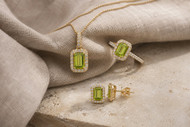
Peridot: The August Birthstone That Forms in the Earth's Mantle
Posted by Rachna Patel Hiro - Little Europe Gem Society on 1st Sep 2026
The Birthstone Series · August
Most coloured stones are made in the crust. Peridot is not. It is one of the very few gems that forms in the earth's mantle and has to be carried to the surface by force — and once you know that, you never quite look at it the same way again.
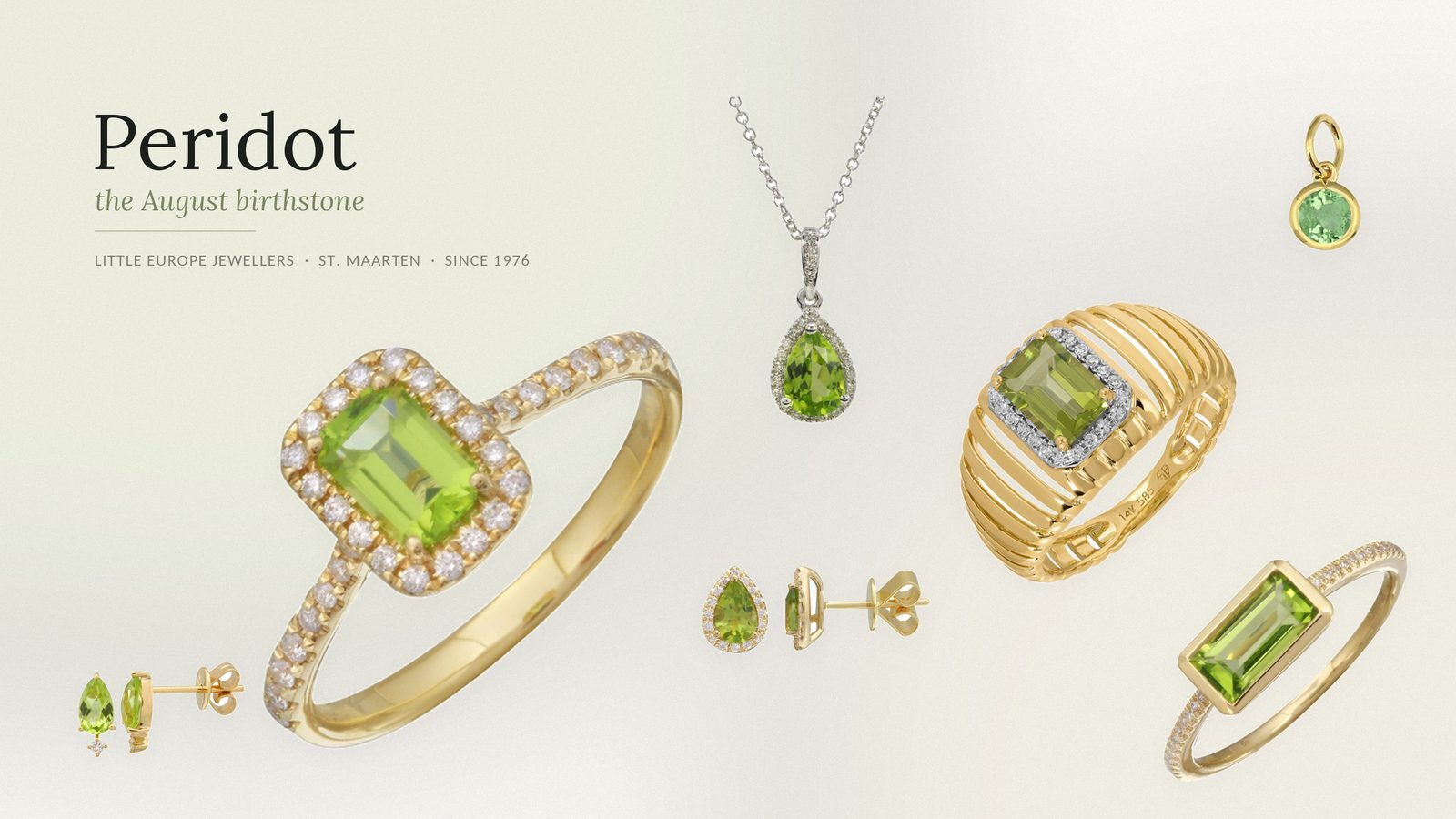
A selection of our August pieces in 14k yellow and white gold.
It is green because of what it is, not what got into it
Almost every coloured gemstone you can name owes its colour to an accident. Corundum is colourless; add a trace of chromium and it becomes ruby, add iron and titanium and it becomes sapphire. Beryl is colourless; a little chromium makes emerald, a little iron makes aquamarine. The colour is an impurity — a guest in the crystal.
Peridot doesn't work that way. It is the gem variety of olivine, and iron is not a guest in olivine — it is part of the recipe. That single fact has a consequence people rarely think about: peridot has no other colour to be. There is no blue peridot, no pink peridot, no colourless peridot waiting to be found. Every stone that has ever come out of the ground is somewhere on a narrow band between yellowish-green and a deep, slightly oily olive. The variation is in saturation, not in hue.
For a client, that is unusually reassuring. When you are choosing a sapphire you are choosing between a hundred greens, blues, pinks and yellows and hoping you have judged the light correctly. With peridot the question is far simpler: how much green, and how clean.
There is no blue peridot, no pink peridot, no colourless peridot waiting to be found.
The stones came up from about fifty miles down
Olivine is one of the most common minerals on this planet — it just happens to spend almost all of its existence somewhere you cannot reach it. The upper mantle is largely made of the stuff, tens of miles beneath the crust, and it stays there unless something violent brings it up.
Two things do. The first is volcanism: rising basalt magma tears loose fragments of mantle rock and carries them to the surface, which is why peridot turns up in lava flows in Arizona, China and Vietnam. The second route is rarer and considerably stranger — peridot is one of the only gemstones that also arrives from space, embedded in pallasite meteorites, fragments of the mantle of a shattered planet that never finished forming.
There is a small local irony in selling it here. Sint Maarten is itself a volcanic island — the hills behind Philipsburg are what is left of the same process, on a smaller scale, that delivers peridot to the surface everywhere else in the world. We are, in a modest way, standing on the mechanism.
Zabargad, and three and a half thousand years of confusion
The historic source is a small, waterless, wind-scoured island in the Red Sea that the Egyptians called Topazios and that appears on modern charts as Zabargad. It has been worked, on and off, for something like three and a half millennia. Ancient accounts describe miners searching at night, because the stones were easier to spot in the dark and could be marked and recovered at first light — a story that has been retold often enough that it should be treated as tradition rather than documented fact, but which fits the material better than most gem legends do.
What is not in doubt is how thoroughly peridot has been mistaken for other things. Some of the most celebrated "emeralds" in Europe are nothing of the kind: the large green stones on the Shrine of the Three Kings in Cologne Cathedral, admired as emeralds for centuries, are peridot. A number of gems in historic collections catalogued as emerald or as chrysolite have quietly been reclassified as the same stone. For a gem with only one colour, it has led a remarkably complicated identity.
Why it was called the evening emerald
Here is the property that matters most in practice, and the one we point out to clients in the shop.
Most green stones lose their nerve under artificial light. Emerald in particular can go flat and grey once you leave daylight — it is a stone that wants a window. Peridot does the opposite. Its green holds under candlelight, lamplight and evening light, and in some stones appears to deepen. The German trade name for it was Abendsmaragd — evening emerald — and the phrase has followed the stone into English ever since. It is not marketing. It is an observation anyone can make by carrying a peridot from a window to a lamp.
It is also, for our climate, the practical argument. A stone that performs at eight in the evening on a terrace, under warm light, with no daylight to help it, is a stone that suits the way people actually dress here.
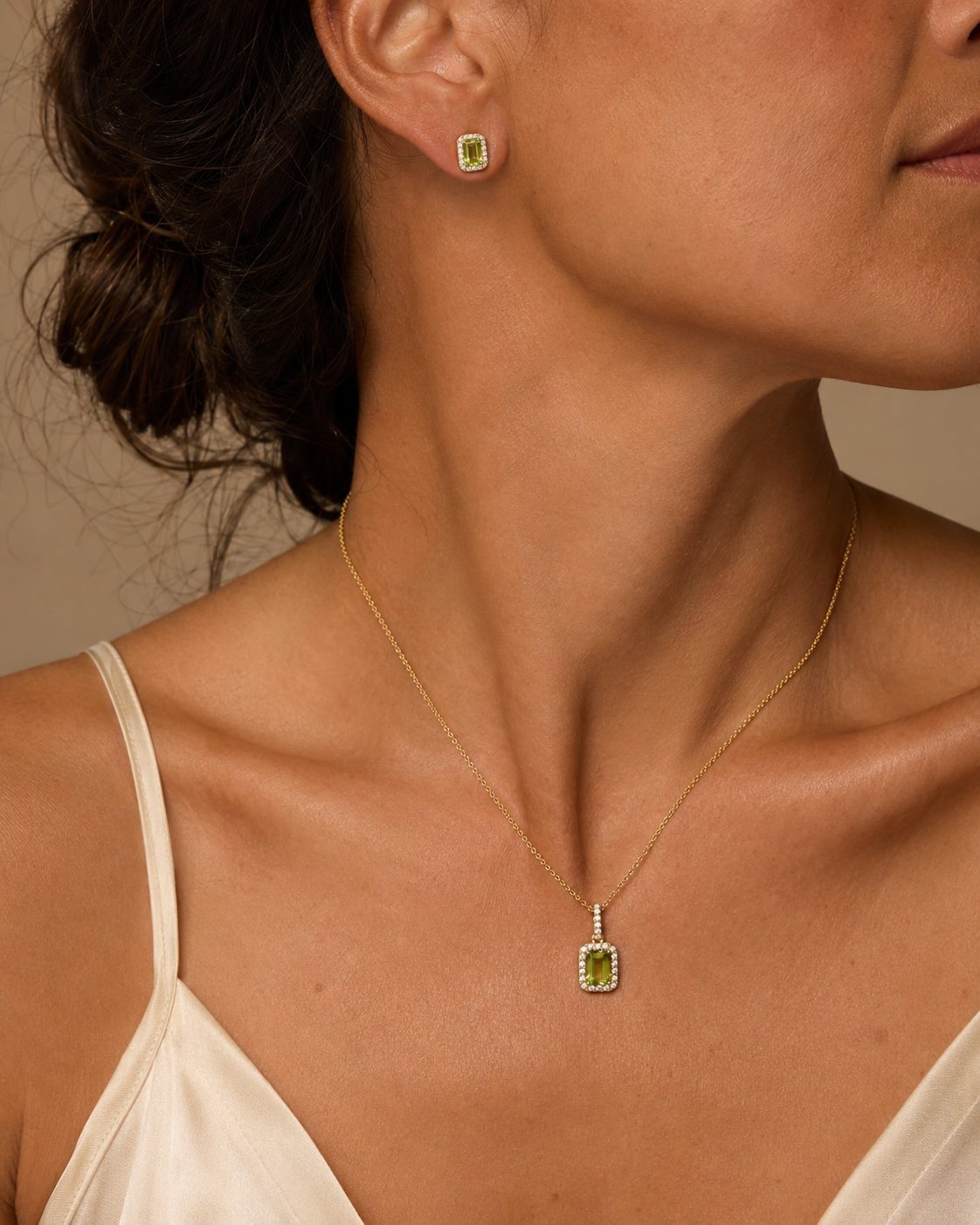
The emerald-cut pendant and studs in 14k yellow gold.
What to look at, if you are choosing one
- Green over yellow. The finest peridot is green with as little yellow or brown in it as possible. Most stones in jewellery lean yellowish-green; the further toward pure green, the rarer and the more valuable.
- Size changes the colour. Peridot's saturation builds with depth of stone. Small stones read bright and lively; larger ones — above roughly 10 × 8 mm — start to show the richer, denser green the material is capable of. This is why a 4 × 6 mm oval and a large emerald cut can look like two different gems.
- Look for doubling. Peridot has unusually strong double refraction. Through a loupe, the back facet edges of a well-cut stone appear as two lines rather than one. It is a normal optical property, not a flaw, and it is one of the quickest ways to distinguish peridot from glass or from green cubic zirconia.
- Lily pads. Under magnification you may see small, flat, disc-shaped reflective inclusions. They are characteristic of the species and, to a gemmologist, a mark of authenticity. Black mineral crystals visible without magnification are a different matter and do reduce value.
- Eye-clean is the standard. Fine peridot should show no inclusions to the naked eye.
Peridot at a glance
- Species
- Gem-quality olivine
- Colour
- Yellowish-green to olive — the only colour it occurs in
- Hardness
- 6.5–7 on the Mohs scale
- Formed
- In the earth's mantle, roughly fifty miles down
- Historic source
- Zabargad, Egypt — worked for some 3,500 years
- Also found
- Arizona, China, Vietnam, Pakistan, Myanmar — and in meteorites
- Care
- Warm soapy water and a soft brush. Never ultrasonic or steam
- Birth month
- August, with spinel and sardonyx
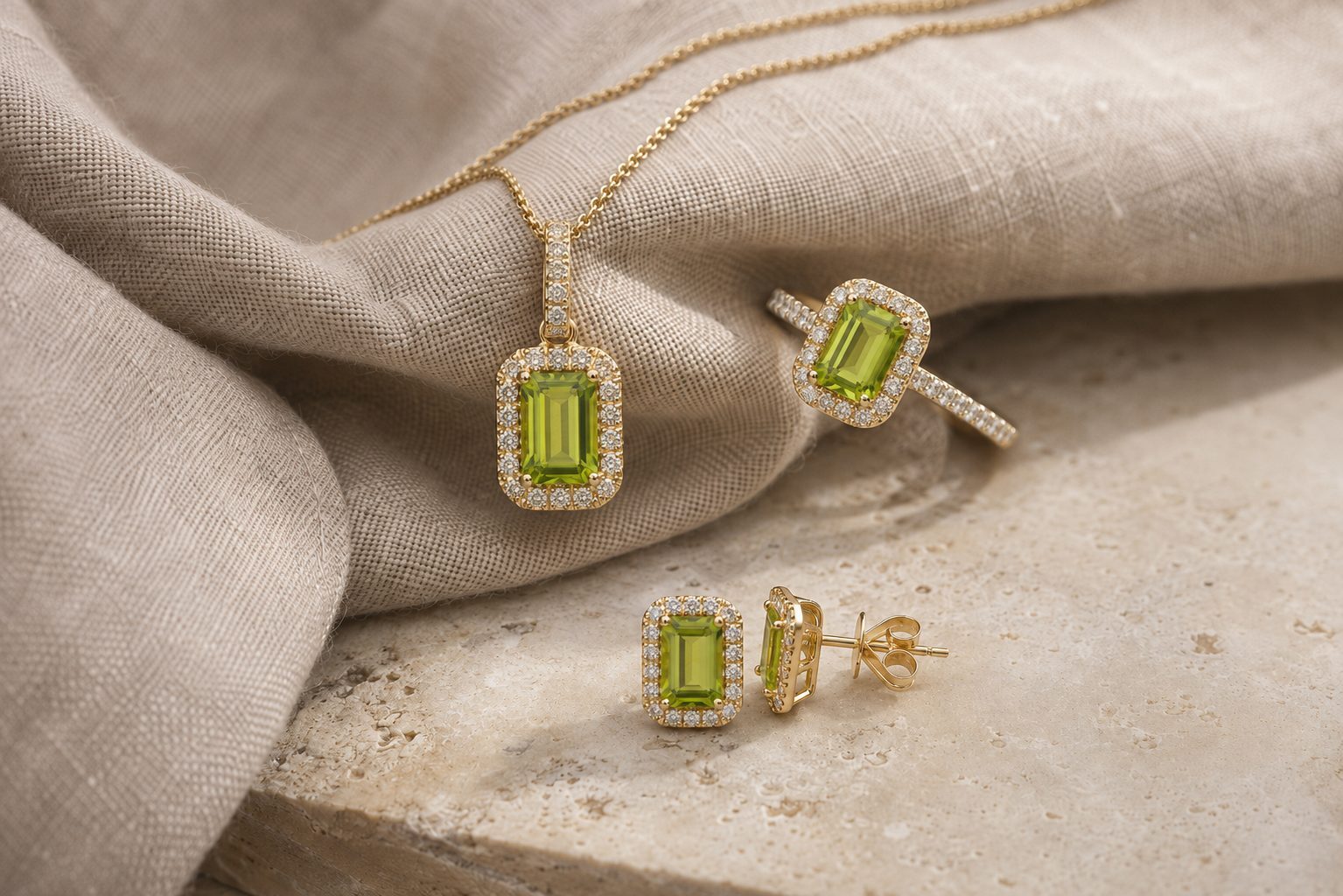
Emerald-cut peridot with a diamond halo, in 14k yellow gold.
Living with it
Peridot sits at 6.5 to 7 on the Mohs scale. That is perfectly wearable — it is harder than opal, tanzanite or moonstone — but it is softer than sapphire or diamond, and it has two habits worth knowing about.
It dislikes sudden temperature change, and it dislikes acid. In practice: never put peridot through an ultrasonic or steam cleaner; wash it in warm soapy water with a soft brush and dry it properly. Put it on after perfume and hairspray, not before. Store it apart from harder stones so nothing scratches the table facet. Rings take more punishment than earrings and pendants, which is one reason the pendant and stud settings in our August collection tend to outlast the rings in condition.
None of this is onerous. It is the same care you would give a good emerald, with rather less anxiety attached.
August has three birthstones — this is the one people mean
Officially, August is shared between peridot, spinel and sardonyx. Sardonyx is the oldest of the three and now the least worn. Spinel is the newest, added by the American trade in 2016 — a long-overdue correction, given how many celebrated historic "rubies" turned out on examination to be spinel. But peridot is the one that made the month, and it is the one clients ask for.
The August collection
We hold peridot in 14k yellow and white gold across the full range: bezel-set birthstone charms and bracelets for the pieces people add to a stack, diamond-haloed studs, pendants and rings in round, oval, pear and emerald cuts, and one or two heavier statement pieces — a ridged yellow-gold dome ring set with an emerald-cut peridot among them.
Several of the halo styles are made as matched suites — the same stone shape and setting as a ring, a pendant and a pair of studs — which is the easiest way to build a set over time rather than all at once. Ask us which families run complete.
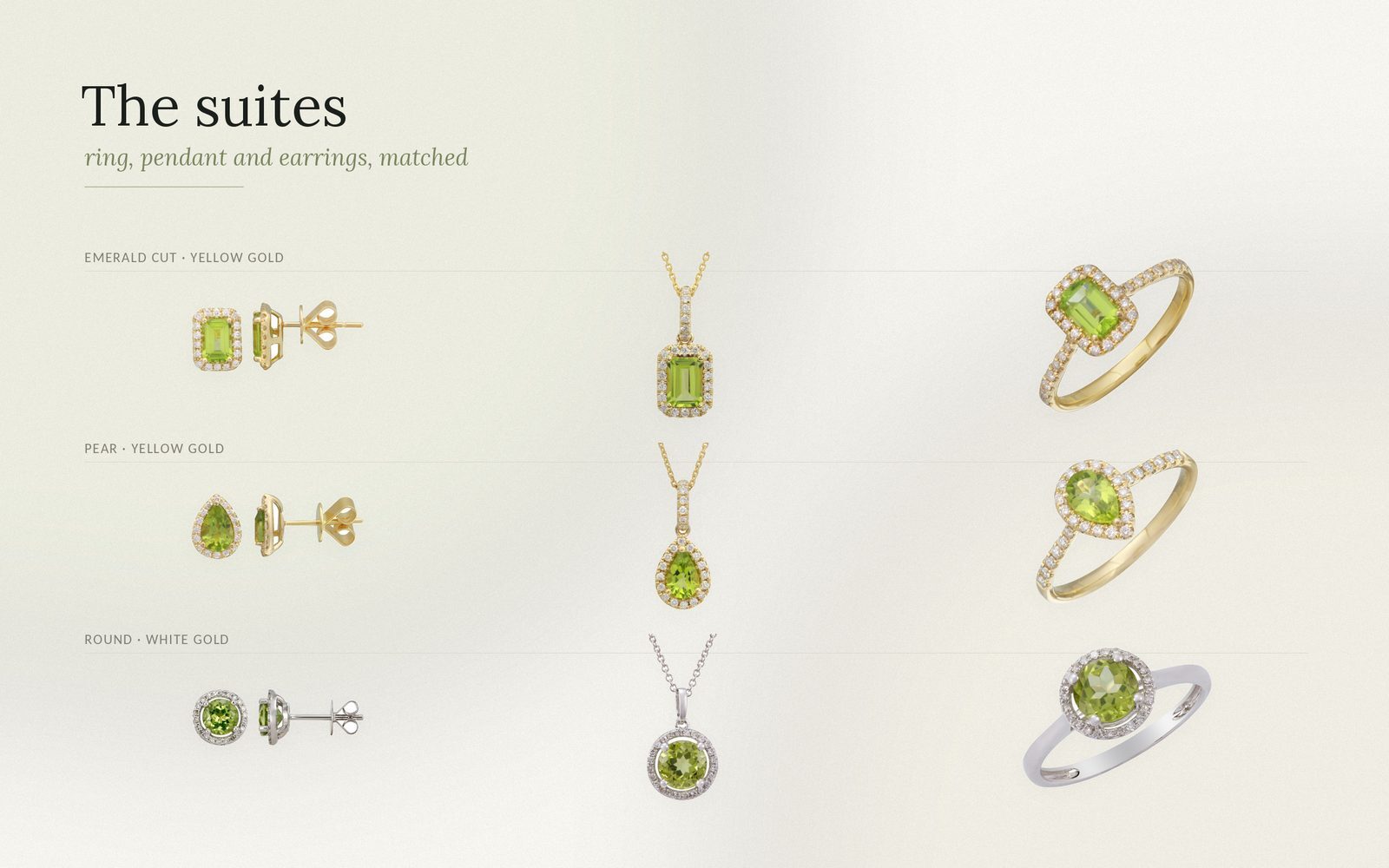
Ring, pendant and earrings, matched — three of the families we hold.
Several styles are made to order in small runs rather than held deep in stock, so a piece you like may need a short lead time. If you have a date in mind, tell us early and we will work back from it. Pricing is negotiable, and we would rather talk you into the right stone than the nearest one — speak with us about the piece.
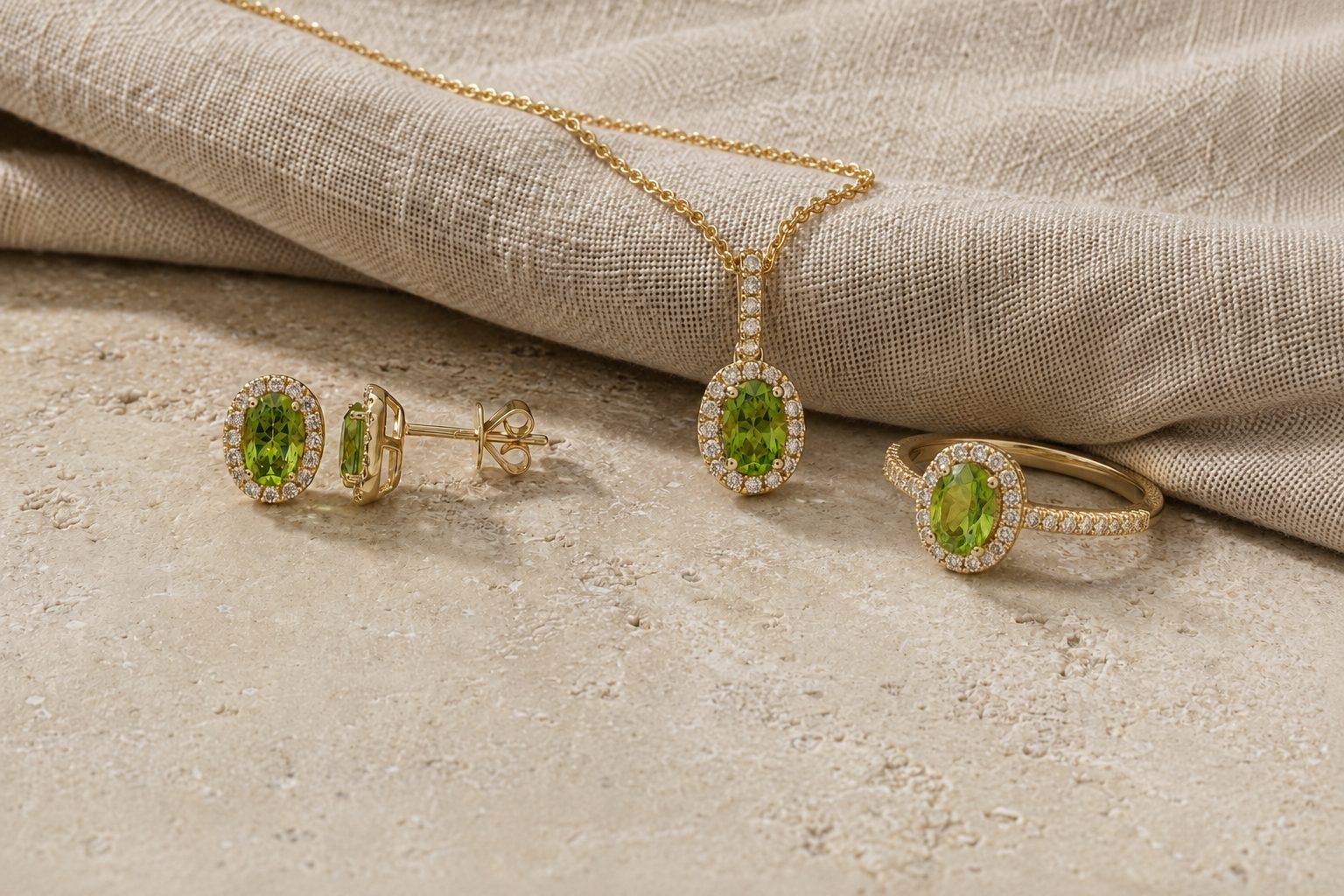
The oval suite, in 14k yellow gold.
Visit us on Front Street, Philipsburg, or message us and we will send images and stone details for anything in the collection. Message us on WhatsApp
Next in the series: September — sapphire.